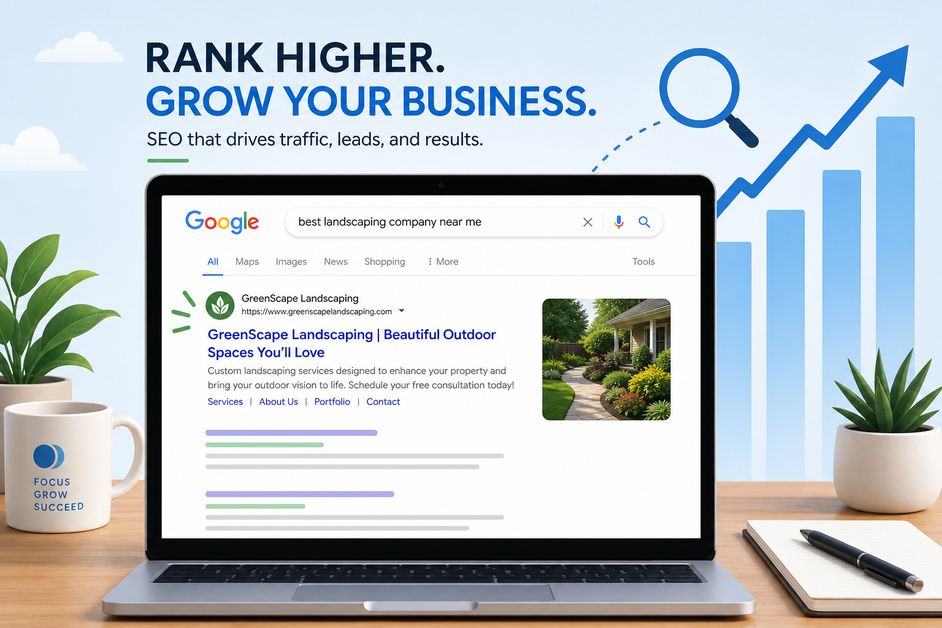
Let’s be honest — the phrase “SEO” probably makes your eyes glaze over. It sounds like something you need a tech degree to understand. But here’s the truth: the fundamentals of SEO for small businesses aren’t complicated. And if you get the basics right, you can start showing up on Google without spending thousands of dollars a month on an agency.
What Is SEO, Really?
SEO stands for Search Engine Optimization. In plain English, it’s everything you do to help Google understand what your website is about — so Google can show it to people searching for exactly what you offer.
When someone types “affordable plumber near me” or “best bakery in town” into Google, the search engine runs through billions of pages to decide which ones to show first. SEO is how you make sure your business is one of them.
The 4 Pillars Every Small Business Owner Should Know
1. Keywords: Speak the Language Your Customers Use
Keywords are the words and phrases your potential customers type into Google. The key is to use the same language they use — not industry jargon.
A dentist shouldn’t just optimize for “orthodontic services.” They should also target “braces for adults,” “how much do Invisalign cost,” and “dentist accepting new patients.” Think about what your customers actually type when they’re looking for help.
Free tools like Google’s own search bar (look at the auto-complete suggestions) and Google Search Console can show you what terms people are already using to find your site.
2. On-Page SEO: Give Google Clear Signals
Once you know your keywords, you need to put them in the right places on your website. This includes:
- Page titles — the headline that appears in browser tabs and search results
- Meta descriptions — the short snippet under your title in Google results (this doesn’t directly affect ranking but hugely affects click-through rate)
- Headings (H1, H2, H3) — the structural headers on each page
- Body content — naturally weaving your target keywords into your page copy
- Image alt text — a brief description of each image (Google can’t “see” images the way humans can)
None of this means stuffing keywords in everywhere. Google is smart enough to penalize that. Write naturally, and let the keywords fit in organically.
3. Technical SEO: Make Your Site Easy to Crawl
Google uses automated “crawlers” to index your site. If your site loads slowly, breaks on mobile, or has broken links, those crawlers will have a hard time — and so will your rankings.
The most important technical factors for small business websites:
- Page speed — Google prioritizes fast-loading sites. Compress images, use caching, and choose quality hosting.
- Mobile-friendliness — Over 60% of searches happen on phones. If your site doesn’t work on mobile, you’re losing both visitors and rankings.
- HTTPS (SSL certificate) — That padlock in the browser bar isn’t just for show. Google marks non-HTTPS sites as “not secure” and ranks them lower.
- Clean URL structure — URLs like yoursite.com/services/web-design are better than yoursite.com/page?id=42
4. Content: The Long Game That Pays Off
Google rewards websites that publish helpful, relevant content consistently. That’s why blogging still matters in 2026. Every new post is a new page Google can index — a new opportunity to rank for a different search term and reach a different customer.
You don’t need to post every day. Even publishing two or three quality posts per month on topics your customers care about will compound over time. Think of it as planting seeds — some will bloom in weeks, others in months, but they keep working for you long after you publish.
The One Thing Most Small Businesses Skip
Most small business owners do none of the above — which means the opportunity for you is real. The competition for many local and niche keywords is surprisingly low. A well-optimized website with a few good blog posts can outrank larger companies that have neglected their SEO.
The key is to start. Fix your page titles. Write a few blog posts. Make sure your site loads fast on mobile. These aren’t glamorous tasks, but they move the needle — and they’re the foundation everything else is built on.
Need Help Getting Your Website SEO-Ready?
At Ignitr Digital, we build websites designed to rank. From clean site structure to speed-optimized hosting, every site we design is built with SEO in mind from day one. Whether you need a new website or want to improve your current one, we’re here to help.
Ready to get found on Google? Let’s talk.
Leave a Reply